
A total station is one of the most important instruments used in modern land surveying, construction, infrastructure development and civil engineering projects. It combines an electronic theodolite, Electronic Distance Measurement (EDM) technology and an onboard data-processing system to measure horizontal angles, vertical angles and distances with high precision.
Whether you are a professional land surveyor, civil engineer, construction contractor or surveying equipment buyer, choosing the right total station can improve measurement accuracy, save field time and make project execution more efficient.
In India, total stations are widely used for land surveys, road construction, building layouts, topographic mapping, boundary surveys and infrastructure projects. Several models are available with different accuracy levels, measuring ranges and features.
In this guide, we will explain total station types, working principles, applications, accuracy, important features and the approximate total station price in India to help you make an informed purchasing decision.
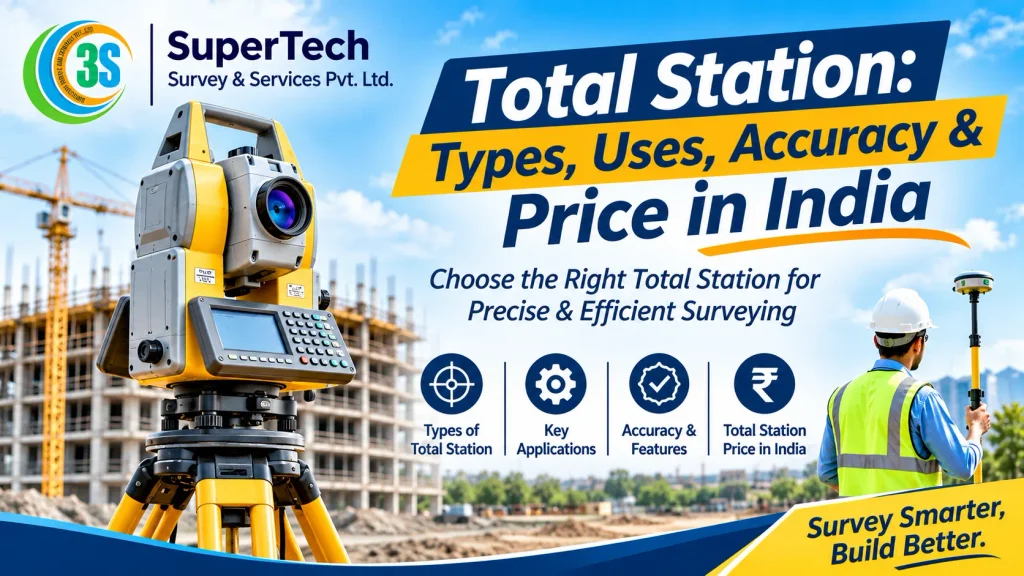
What Is a Total Station?
An electronic surveying tool called a total station uses measurements of angles and distances to pinpoint the exact location and coordinates of points on the ground.
It integrates three main technologies:
- Electronic Theodolite: Measures horizontal and vertical angles.
- Electronic Distance Measurement (EDM): Measures distances using an electronic signal.
- Data Processing System: Calculates coordinates, elevations and other survey information.
Modern total stations also include onboard software, internal memory, USB connectivity, Bluetooth and reflectorless measurement capabilities, depending on the model.
For surveying professionals, a total station is useful because it combines multiple measurement functions in one instrument.
How Does a Total Station Work?
A total station works by measuring the angle and distance between the instrument and a selected survey point.
The basic working process involves the following steps:
- Instrument Setup: Place the total station on a tripod and centre it over a known survey point.
- Levelling: Adjust the instrument using its levelling screws and electronic bubble.
- Coordinate Setup: Input the necessary instrument height and station coordinates.
- Target Positioning: Place a prism reflector at the point to be measured, or use reflectorless measurement if supported.
- Measurement: The device calculates slope distances, vertical angles, and horizontal angles.
- Data Calculation: Its internal processor calculates coordinates and elevation values.
- Data Storage: Save the collected survey points for further processing and mapping.
The collected data can subsequently be transferred to compatible surveying or CAD software for further analysis and project documentation.
Types of Total Station Instruments
Different total station instruments are designed for different surveying requirements. The most common types include:
1. Conventional Total Station
A conventional total station is widely used for general land surveying, construction layouts and engineering projects.
It measures horizontal angles, vertical angles and distances using a prism or reflectorless EDM, depending on the model.
Applications:
- Land and boundary surveys
- Building construction layouts
- Road and highway surveys
- Topographic surveys
2. Reflectorless Total Station
A reflectorless total station measures distances without requiring a prism at the target point.
It is particularly useful when the surveyor cannot safely access the measurement location, such as building facades, elevated structures and restricted areas.
Key benefits:
- Faster measurements in suitable conditions
- Reduced need for prism positioning
- Convenient measurements of inaccessible points
3. Robotic Total Station
A robotic total station uses motorised technology to automatically track a prism and support remote operation.
It can reduce the need for multiple field personnel and improve productivity on large construction and engineering projects.
Applications:
- Large construction sites
- Building monitoring
- Road and infrastructure projects
- High-precision engineering surveys
4. Manual Total Station
A manual total station requires the surveyor to operate and aim the instrument manually.
It is suitable for routine surveying work, small construction projects and general land measurement requirements.
5. Imaging and Advanced Total Stations
Advanced total stations may include integrated cameras, enhanced connectivity, onboard applications and other technologies.
Depending on the model, these features can support visual documentation, remote operation and more efficient field workflows.
Main Uses of Total Station in Surveying
A total station is used in several industries because it provides accurate measurements and coordinate information.
Here are some important applications:
1. Land and Boundary Survey
Surveyors use total stations to determine land dimensions, property boundaries, coordinates and plot layouts. These measurements help in preparing survey maps and planning development activities.
2. Building Construction
During construction, total stations help transfer design coordinates to the ground. Engineers use them for foundation layouts, column positioning, alignment and structural measurements.
3. Road and Highway Survey
Total stations are used for road alignment, centreline marking, cross-section surveys, elevation measurements and construction monitoring.
4. Topographic Survey
A total station collects ground points to prepare topographic maps showing elevations, contours, slopes and existing site features.
5. Mining and Infrastructure Projects
Mining professionals and infrastructure engineers use total stations for site measurements, positioning, layout work and monitoring applications.
6. Bridge and Structural Monitoring
High-precision instruments can help monitor structural movement, deformation and changes in the position of selected points over time.
The required instrument accuracy and monitoring procedure depend on the engineering specifications of the project.
Total Station Accuracy: How Accurate Is It?
Total station accuracy depends on the instrument model, angular measurement accuracy, EDM specifications, operating conditions and survey methodology.
Two important accuracy specifications are:
1. Angular Accuracy
Angular accuracy is generally expressed in arc-seconds (“). Common instrument specifications include 1″, 2″, 3″ and 5”.
A lower angular accuracy value indicates finer angular measurement capability.
2. Distance Measurement Accuracy
Distance accuracy is commonly expressed in millimetres plus parts per million (ppm).
For example, an EDM specification of ±(2 mm + 2 ppm × D) indicates that measurement uncertainty includes a fixed component and a distance-dependent component.
Other factors that affect field accuracy include:
- Instrument centring and levelling
- Prism constant and target positioning
- Atmospheric temperature and pressure
- Instrument calibration
- Surveyor experience
- Site visibility and measurement conditions
For high-precision engineering work, always select an instrument according to the project’s specified accuracy requirements rather than choosing only by price.
Total Station Price in India
The total station price in India varies according to the brand, model, angular accuracy, reflectorless range, software, accessories and technology.
Based on indicative Indian market listings, conventional instruments can start around ₹1.5 lakh, while advanced and robotic models may cost considerably more.
The following table provides broad indicative buying ranges, not fixed quotations.
| Total Station Category | Indicative Price Range |
| Basic conventional models | ₹1.5–2.5 lakh |
| Standard surveying models | ₹2.5–4 lakh |
| Advanced reflectorless models | ₹3.5–6 lakh |
| High-precision models | ₹4–8 lakh |
| Robotic total stations | ₹8–18 lakh or more |
Actual prices depend on the model, specifications, availability and supplier quotation. These ranges should be verified before making a purchase.
Factors Affecting Total Station Price
Before purchasing a total station, consider these important factors:
- Angular Accuracy: Higher-precision instruments may cost more.
- Reflectorless Range: Longer non-prism measurement capability can influence the price.
- Brand and Model: Different manufacturers offer different technology and specifications.
- Software and Connectivity: Advanced onboard software, Bluetooth and data-transfer facilities can affect pricing.
- Warranty and Support: Warranty coverage, technical assistance and after-sales service are important considerations.
- Accessories: Batteries, chargers, prisms, tripods and carrying cases may affect the overall purchase cost.
For the latest model-wise pricing, request a quotation from a reliable total station supplier in India.
How to Choose the Best Total Station for Surveying?
Selecting the right total station depends on your project requirements, working environment and budget.
Consider the following points before purchasing:
- Identify Your Application: Decide whether you need the instrument for land surveys, building layouts, roads or large infrastructure projects.
- Check Angular Accuracy: Select 1″, 2″, 3″ or 5″ accuracy according to project requirements.
- Compare EDM Range: Check both prism and reflectorless measuring ranges.
- Evaluate Data Storage: Look for sufficient internal memory and convenient data-transfer options.
- Check Battery Performance: Longer battery backup is useful for extended fieldwork.
- Consider Technical Support: Choose a supplier that can assist with installation, operation, maintenance and servicing.
- Compare Total Cost: Consider accessories, warranty and long-term service requirements, not just the instrument price.
A reliable supplier can help you compare different models and select suitable equipment for your surveying applications.
Why Choose SuperTech Survey for Total Station Instruments?
SuperTech Survey & Services Pvt. Ltd. is a surveying equipment supplier established in 2014 in Noida, Uttar Pradesh, India.
The company offers surveying instruments and geospatial equipment for professionals working in land surveying, construction, mapping and infrastructure development.
Its total station product range includes models and brands such as:
- Ruide Total Station
- South Total Station
- Sokkia Total Station
- Horizon Total Station
- Sanding Total Station
The right instrument depends on your project requirements, accuracy needs and budget.
SuperTech Survey also offers surveying equipment and technical support to help customers identify suitable instruments for their applications.
If you are looking for a total station supplier in India, you can explore the available models and contact the team for product specifications and pricing.
Explore: Total Station Instruments – SuperTech Survey
Frequently Asked Questions (FAQs)
1. What is a total station used for in surveying?
A total station is used to measure horizontal angles, vertical angles and distances. It helps surveyors determine coordinates, elevations, land boundaries, construction layouts and topographic details.
2. What are the different types of total stations?
Common types include conventional total stations, reflectorless total stations, robotic total stations, manual total stations and advanced imaging total stations.
3. What is the accuracy of a total station?
Angular accuracy commonly ranges from 1 to 5 arc-seconds in many professional instruments, although specifications vary by model. Distance accuracy is generally expressed in millimetres plus ppm.
4. What is the price of a total station in India?
The price depends on the brand, model, accuracy and features. Basic conventional models may start around ₹1.5 lakh, while advanced and robotic instruments can cost ₹8 lakh or more. Contact a supplier for an updated quotation.
5. Which total station is best for land surveying?
The best total station depends on the survey type, required accuracy, measurement range and budget. Conventional 2″ or 5″ instruments can be suitable for many routine surveying applications, while specialised projects may require higher-precision or robotic models.
6. What is the difference between a total station and a theodolite?
A theodolite primarily measures horizontal and vertical angles, whereas a total station combines angle measurement with electronic distance measurement and coordinate calculation.
7. Which factors should I check before buying a total station?
Check angular accuracy, EDM range, reflectorless capability, battery backup, data storage, software, warranty and after-sales technical support.
8. Where can I buy a total station in India?
You can contact SuperTech Survey & Services Pvt. Ltd. in Noida for information about available Ruide, South, Sokkia, Horizon and Sanding total station models, specifications and quotations.
Conclusion
A total station is an essential surveying instrument for accurate land measurement, construction layout, infrastructure development and engineering applications. Understanding its types, working principles, accuracy and pricing helps professionals choose the right equipment for their projects.
Before purchasing, compare different models, evaluate their technical specifications and consider the supplier’s technical support and warranty services.
If you are searching for a reliable total station supplier in India, SuperTech Survey can help you explore suitable surveying instruments according to your project requirements and budget.