
An auto level for surveying is a commonly used optical instrument for measuring differences in elevation and establishing accurate horizontal levels. It is widely used in land surveying, construction, road projects, infrastructure development, and civil engineering.
Choosing the right auto level machine is important for surveyors and construction professionals who need consistent and reliable measurements. Supertech Survey provides surveying instruments and solutions for professionals involved in construction, engineering, and land surveying projects.
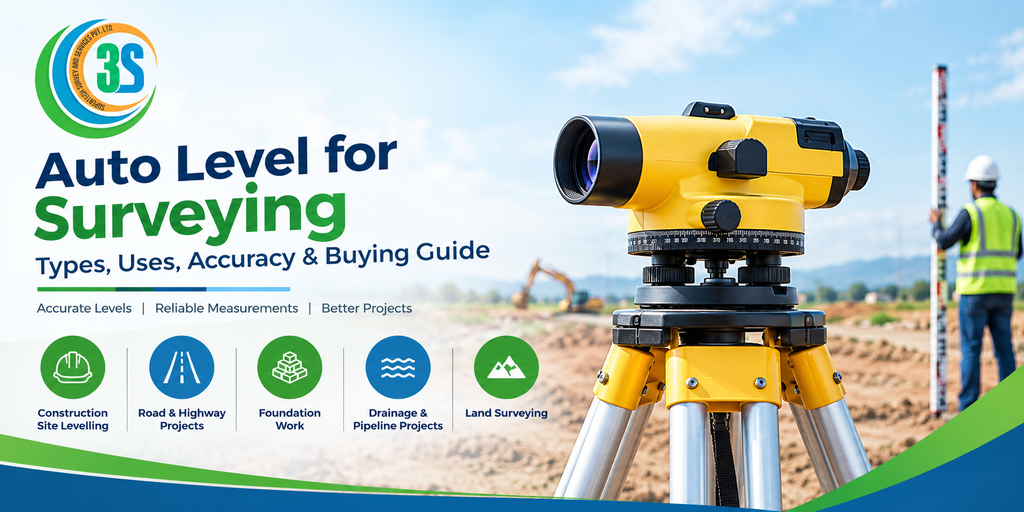
What Is an Auto Level for Surveying?
An auto level is an optical surveying instrument designed to establish a horizontal line of sight automatically. It uses an internal compensator to correct small amounts of instrument tilt and maintain a level line of sight.
The instrument is generally mounted on a tripod and used with a levelling staff. The surveyor observes the staff through the telescope and takes readings at different points. Comparing these readings helps determine differences in elevation.
In simple terms, an auto level for surveying is used to establish levels and measure height differences between points accurately.
How Does an Auto Level Machine Work?
The working principle of an auto level machine is relatively simple:
- The instrument is mounted securely on a tripod.
- Approximate levelling is performed using the foot screws.
- The internal compensator corrects minor remaining tilt.
- The telescope is aimed at the levelling staff.
- Staff readings are taken at different survey points.
- The readings are compared to calculate elevation differences.
Proper setup, a stable tripod, clear staff readings, and correct surveying techniques are important for achieving reliable results.
Types of Auto Level Instruments
Different types of auto level instruments are available depending on the accuracy and application requirements.
1. Standard Automatic Level
A standard automatic level is suitable for general surveying and construction activities. Common applications include:
- Building construction
- Site levelling
- Foundation work
- Road construction
- Drainage projects
- General land surveying
2. High-Precision Auto Level
High-precision auto levels are designed for applications requiring greater levelling accuracy. They can be useful for engineering surveys, infrastructure projects, benchmark establishment, and precision construction work.
3. Digital Level
A digital level uses electronic measurement technology to provide readings digitally. It can reduce manual reading errors and may provide a faster workflow for specialized surveying applications.
Uses of Auto Level for Surveying
An auto level for surveying has applications across construction, land development, and civil engineering.
Construction Site Levelling
Auto levels help establish reference elevations and check whether different parts of a construction site are at the required level. They are also useful for transferring levels between locations.
Road and Highway Projects
Road construction requires accurate elevation and gradient control. An auto level machine can be used for roads, pavements, embankments, and drainage structures.
Foundation Work
Accurate reference levels are important before foundation construction. An auto level instrument can help identify elevation differences and establish the required levels across a site.
Drainage and Pipeline Projects
Drainage systems and pipelines often require specific gradients. Auto levels help determine elevation differences and establish the required slope between points.
Land Surveying
Auto levels can be used to determine relative elevations during land and engineering surveys. They are useful for site preparation, topographical work, and general construction planning.
How Accurate Is an Auto Level?
The accuracy of an auto level depends on factors such as instrument specifications, compensator performance, telescope quality, staff condition, setup, and field conditions.
Manufacturers commonly specify levelling accuracy in terms such as millimetres per kilometre of double-run levelling. Therefore, buyers should check the manufacturer’s stated accuracy rather than assuming every auto level provides the same performance.
A standard automatic level may be sufficient for routine construction work, while precision engineering projects may require a higher-accuracy model.
Factors That Affect Accuracy
- Instrument calibration
- Tripod stability
- Staff condition
- Correct instrument setup
- Sight distance
- Atmospheric conditions
- Compensator performance
- Surveyor technique
Regular calibration and proper field procedures can help maintain reliable measurement results.
How to Choose the Best Auto Level for Surveying?
Before purchasing an auto level machine, consider the requirements of your project rather than focusing only on price.
1. Accuracy
Select an instrument according to the required level of accuracy. General construction may require a standard model, while precision projects may need a higher-accuracy instrument.
2. Telescope Quality
A clear telescope with suitable magnification makes it easier to observe the levelling staff, especially when working over longer distances.
3. Compensator
The compensator is an important component of an automatic level. A reliable compensator helps maintain a horizontal line of sight after approximate levelling.
4. Working Range
Consider the typical distance between the instrument and staff. Choose a model that provides clear observations across the required working range.
5. Durability
Surveying equipment is frequently used outdoors. A durable instrument can be beneficial for regular use on construction and infrastructure sites.
6. Calibration and Service
Choose a supplier that can provide calibration, repair, technical assistance, accessories, and after-sales support. Proper maintenance is important for long-term measurement reliability.
Auto Level vs Total Station
An auto level and a total station are designed for different surveying requirements.
An auto level is primarily used for levelling and determining elevation differences. It is a practical choice when the main requirement is accurate height measurement.
A total station combines angle and distance measurement and is suitable for advanced tasks such as coordinate measurement, detail surveying, and setting out.
Choose an auto level when:
- Your primary requirement is levelling.
- You need to establish elevations.
- You regularly check construction levels.
- You need a straightforward optical instrument.
Choose a total station when:
- You need angle and distance measurements.
- Coordinate-based surveying is required.
- Advanced setting-out capabilities are needed.
Why Choose a Reliable Surveying Equipment Supplier?
The right supplier can be just as important as the right instrument. A reliable surveying equipment supplier should ideally provide genuine products, technical guidance, calibration, repair, accessories, and after-sales support.
Supertech Survey provides surveying instruments and solutions for professionals involved in land surveying, construction, civil engineering, and infrastructure projects. Professional technical support can help users select equipment according to their specific project requirements.
Frequently Asked Questions
What is an auto level used for?
An auto level is mainly used to establish a horizontal line of sight and determine elevation differences between points. It is widely used in construction, land surveying, road projects, drainage, and civil engineering.
What is an auto level machine?
An auto level machine is an optical levelling instrument with an internal compensator. It helps establish a horizontal line of sight and measure relative elevation differences.
Is an auto level accurate for surveying?
Yes. An auto level can provide accurate and reliable results when it is properly calibrated, correctly set up, and used with appropriate surveying procedures.
What is an auto level instrument used for?
An auto level instrument is used for construction levelling, foundation work, elevation transfer, road projects, drainage, land surveying, and other applications requiring accurate level measurements.
How do I choose an auto level for surveying?
Consider accuracy, telescope quality, compensator performance, working range, durability, calibration support, and after-sales service. Select a model that matches the technical requirements of your project.
Conclusion
An auto level for surveying is a practical instrument for establishing horizontal levels and measuring elevation differences. It is widely used in construction, land surveying, road development, drainage, and civil engineering.
When choosing an auto level machine or auto level instrument, consider accuracy, telescope performance, compensator quality, durability, calibration, and supplier support rather than price alone.
For professional surveying requirements, Supertech Survey provides surveying equipment and solutions to help professionals select suitable instruments for their specific project needs.